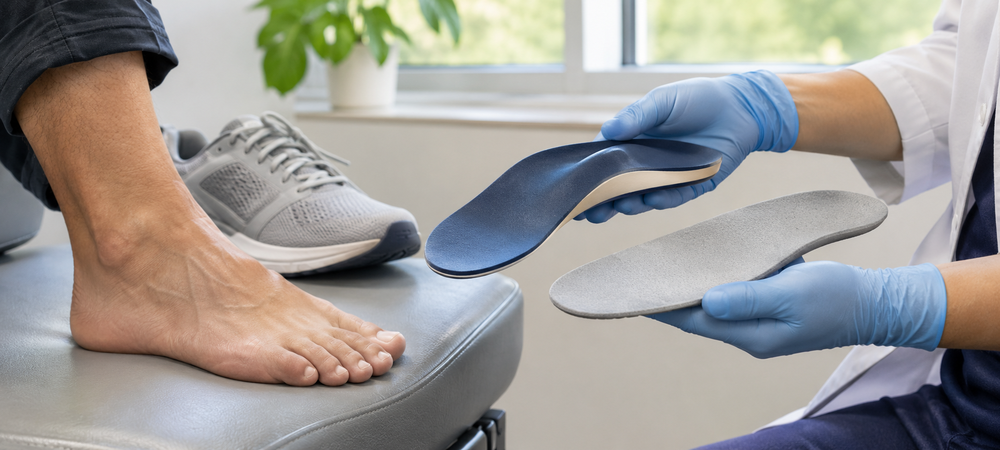
A shoe insert can make a hard floor or long workday feel more comfortable, but comfort alone does not reveal why a foot hurts. Persistent heel pain, recurring arch fatigue, pressure beneath the forefoot, or a change in the way you walk may call for more than choosing the softest product on a store shelf. The useful question is not simply whether custom orthotics are “better.” It is which device, if any, matches the condition, your foot mechanics, your shoes, and the activities you need to perform.
New Hope Podiatry Group of Los Angeles evaluates foot and ankle concerns and lists custom orthotics and bracing among its services. A podiatry evaluation can distinguish a simple need for cushioning from a problem that may benefit from a prescription device, a different conservative treatment, or further testing. This article explains the practical differences between over-the-counter inserts and prescription custom orthotics without assuming that either option is right for every person.
 What Is the Difference Between a Shoe Insert and a Custom Orthotic?
People often use “insert,” “insole,” “arch support,” and “orthotic” as if they mean the same thing. In practice, the terms describe products with different levels of evaluation and individualization. The APMA overview of prescription orthotics and shoe inserts explains that a prescription orthotic is made for a specific patient after a podiatrist evaluates the feet, ankles, legs, and movement. A mass-produced product bought in a store or online is a shoe insert, even when its marketing uses words such as “custom fit.”
Store-bought inserts
Over-the-counter inserts are manufactured in standard shapes and sizes. Some add soft cushioning, some raise the arch, and others provide a heel cup or a firmer platform. They can be useful when the goal is modest comfort, shock absorption, or support in a particular pair of shoes. They are also relatively easy to replace or move between shoes.
Their main limitation is that selection usually occurs without a diagnosis or a detailed assessment of how the foot functions. A product that feels supportive to one person may create pressure for another. Size markings also do not guarantee that the insert will match the shoe volume, arch location, heel width, or activity.
Prescription custom orthotics
Prescription custom orthotics are designed around a clinician’s findings and a three-dimensional representation or measurements of the feet. The prescription can address the shape, materials, posting, cushioning, and intended function of the device. Functional devices are generally intended to influence motion or loading, while accommodative devices emphasize cushioning and pressure redistribution. The design should reflect a specific clinical goal rather than a generic promise to “fix” the foot.
A custom device may still require adjustment. Feet, symptoms, shoes, and activity demands vary, and a laboratory-made orthotic is not automatically comfortable or effective simply because it is individualized. Follow-up is part of responsible use.
Start With the Symptom, Not the Product Label
Foot pain can come from many structures, including skin, nails, fascia, tendons, ligaments, joints, bones, nerves, and blood vessels. Similar-sounding symptoms can therefore need different responses. Heel pain after the first steps in the morning is not evaluated the same way as burning pain with numbness, a swollen joint, a stress injury, or a pressure spot in a person with diabetes.
An insert may change where pressure is felt, but it cannot establish the cause of pain. It also should not delay evaluation of symptoms that are persistent, worsening, associated with an injury, or accompanied by numbness, color change, an open sore, drainage, fever, or an inability to bear weight. Those features can require prompt medical attention, and an emergency may need urgent or emergency care rather than an office appointment.
This diagnosis-first approach is especially important because orthoses are not a universal treatment. They may be one part of care for selected conditions, or a clinician may recommend shoe changes, activity modification, stretching, physical therapy, medication, immobilization, wound care, or another option depending on the findings.
When a Store-Bought Insert May Be a Reasonable First Step
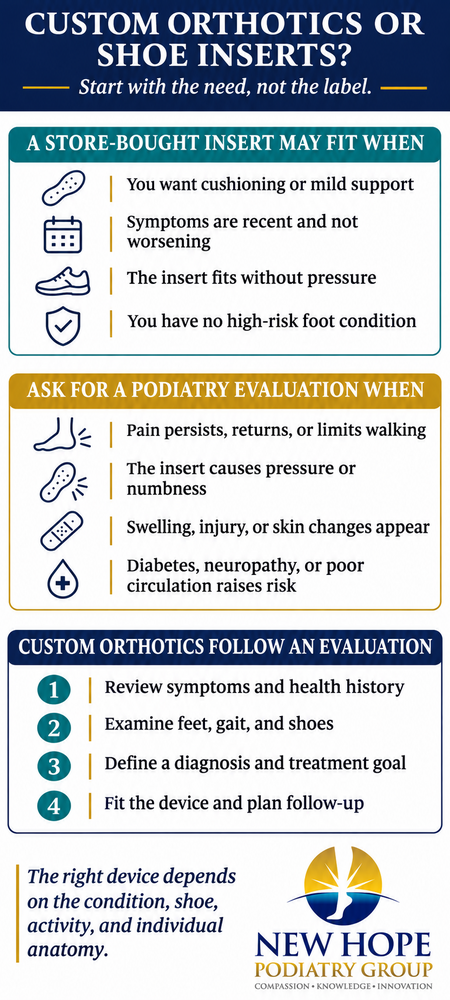
A nonprescription insert may be reasonable when you want extra cushioning or mild support and do not have warning signs or a known high-risk foot condition. Examples include replacing a thin factory insole in a roomy walking shoe or adding modest cushioning for prolonged standing. The product should fit the shoe without crowding the toes or lifting the heel out of the heel counter.
Use comfort as feedback, not as a challenge to “push through.” An insert should not create a new pressure point, numbness, blister, skin discoloration, or increasing pain. If the insert changes the shoe fit, the shoe may no longer accommodate the foot safely. Remove the device and reassess rather than assuming discomfort is a necessary break-in phase.
Consider these practical checks before buying an insert:
- Match the insert to the purpose: cushioning, arch support, heel comfort, work, walking, or sport.
- Bring the shoe you plan to use and confirm that the insert lies flat without folding or sliding.
- Remove the shoe’s factory liner when appropriate so the new insert does not make the shoe too tight.
- Walk in the shoes and notice pressure under the arch, heel, forefoot, and toes.
- Check the skin after use, particularly if you have reduced sensation or circulation concerns.
People with diabetes, neuropathy, poor circulation, a history of ulceration, or a significant deformity should seek professional guidance before relying on a self-selected insert. Reduced sensation can make harmful pressure difficult to detect.
When a Custom Orthotic Evaluation May Be Worthwhile
A custom orthotic is not justified by price or marketing. It becomes a consideration when an examination identifies a problem and an individualized device has a clear purpose. The decision may be more relevant when pain persists despite appropriate footwear and a reasonable trial of basic measures, when symptoms repeatedly return with activity, or when the foot’s structure and motion create demands that a standard insert does not address.
Persistent or recurring symptoms
Pain that continues, interferes with walking or work, or returns whenever activity increases deserves evaluation. A clinician can determine whether the symptoms fit a condition commonly managed with orthoses or point to another cause. This helps avoid spending money on devices that do not address the actual problem.
Complex pressure or alignment needs
A prescription device may allow targeted cushioning, relief beneath a sensitive area, or a defined change in how forces are distributed. That can matter when the feet have substantial asymmetry, a rigid high or low arch, a painful prominence, or another mechanical concern. The goal is not to force every foot into one ideal shape; it is to support the diagnosed need and the person’s function.
Health conditions that increase risk
Diabetes, loss of protective sensation, vascular disease, inflammatory arthritis, and previous foot wounds can change the risk-benefit calculation. In these situations, material choice, total shoe fit, skin inspection, and follow-up may be as important as the shape of the device. An off-the-shelf product should not be used to cover an ulcer or manage a high-risk foot without professional direction.
What Happens During a Podiatry Orthotics Evaluation?
An orthotics visit should begin with the problem you want to solve. The clinician may ask where the pain occurs, when it began, what activities provoke it, what treatments you have tried, and which shoes you wear for work, exercise, and daily life. Medical history matters because nerve function, circulation, arthritis, prior injuries, surgery, and diabetes can affect both the diagnosis and device selection.
Foot, ankle, and movement assessment
The physical examination may include skin condition, tender areas, joint motion, muscle strength, alignment, sensation, circulation, and the relationship between the feet and lower legs. The podiatrist may also observe standing and walking. Imaging is not automatically required for an orthotic, but it may be appropriate when the history or examination suggests a fracture, arthritis, deformity, or another condition that needs clarification.
Shoe and activity review
An effective device has to work inside an appropriate shoe. Bring the footwear used during the activity that causes symptoms. A bulky orthotic in a shallow shoe may crowd the foot, while a flexible racing shoe may not provide the stable platform expected for a particular device. Sometimes improving the shoe is the more useful first change.
Prescription, fabrication, and fitting
If a custom orthotic is appropriate, the clinician records the foot shape and writes a prescription based on the treatment objective. The finished devices should be checked in the intended shoes. The fitting visit is also the time to review a gradual wear plan, cleaning, shoe compatibility, and the symptoms that should prompt a call.
What Does the Evidence Say About Custom and Prefabricated Orthoses?
Research on foot orthoses is diagnosis-specific, and results should not be generalized to every type of foot pain. Studies also use different devices, materials, comparison groups, outcome measures, and follow-up periods. That variation is one reason broad statements such as “custom is always better” or “orthotics never work” are not supported.
For plantar heel pain, an NIH-indexed systematic review of orthoses for plantar heel pain found no clear short-term pain advantage for custom devices over prefabricated or sham orthoses in the pooled comparisons it analyzed. Other research has reported benefits for selected conditions or individuals. The practical conclusion is that a higher level of customization does not guarantee a better result for every diagnosis.
A clinician should connect the device to a documented problem, explain the intended outcome, and discuss reasonable alternatives. For some patients, a well-fitted prefabricated insert may be an appropriate trial. For others, the ability to individualize pressure relief, materials, or mechanical features may support a custom prescription. Progress should be judged by meaningful changes in pain, skin condition, walking tolerance, or function, not by the device category alone.
How to Use Orthotics Without Creating New Problems
Allow time for adaptation, but respect warning signs
A clinician may recommend increasing wear time gradually, especially with a firmer prescription device. Mild awareness of a new support can occur, but sharp pain, numbness, blistering, bruising, or a focal red mark that persists is not a goal. Stop using the device and contact the prescribing office if symptoms worsen or the skin is being injured.
Check the whole shoe-device-foot system
The orthotic, sock, shoe, and foot work together. Keep the device seated flat and inspect it for cracking, compressed cushioning, rough edges, or shifting. Make sure the shoe still has adequate toe space and heel control. Bring both the orthotics and the shoes to follow-up visits so fit can be assessed in the context in which problems occur.
Reassess when circumstances change
Contact the podiatry office if the device no longer controls symptoms, becomes damaged, or causes a new pressure area. A change in body weight, activity, work footwear, surgery, injury, or foot structure can also change what is needed. Children and people with progressive conditions may require periodic reassessment rather than assuming one device will remain suitable indefinitely.
Questions to Ask Before Choosing an Insert or Orthotic
A useful decision is based on a clear clinical purpose. Consider asking:
- What diagnosis or mechanical finding is the device intended to address?
- Would a shoe change or prefabricated insert be a reasonable first trial?
- What benefit should I reasonably expect, and how will we measure it?
- Which shoes and activities should I use the device for?
- How should I increase wear time, and what symptoms mean I should stop?
- Are adjustments and follow-up included, and when should the device be rechecked?
These questions create a more useful conversation than asking only whether custom orthotics are “worth it.” The answer depends on what the device is expected to do and how well that purpose matches your needs.
Arrange a Los Angeles Foot and Ankle Evaluation
If foot pain is persistent, recurring, or changing how you stand or walk, an evaluation can clarify the cause before you commit to a device. New Hope Podiatry’s custom orthotics and bracing service page describes the practice’s orthotics offerings, and the podiatry services offered by New Hope page provides broader service context. Availability and the right treatment depend on an individual assessment.
Schedule an appointment with New Hope Podiatry Group of LA for an evaluation of your foot or ankle concerns. Call the Los Angeles office at (323) 264-6157, or review the Los Angeles office information to learn how to request a visit.
Frequently Asked Questions
1. Are custom orthotics always better than store-bought inserts?
No. Custom devices allow individualized design, but research does not show that they are universally superior for every condition. A prefabricated insert may be a reasonable option for simple cushioning or selected symptoms. The diagnosis, treatment goal, shoe fit, and response to use matter more than the label alone.
2. Can an over-the-counter insert make foot pain worse?
Yes. An insert can crowd the shoe, place pressure under the arch or forefoot, alter heel fit, or rub the skin. Stop using it if it causes new pain, numbness, blistering, discoloration, or a persistent pressure mark. People with reduced sensation or poor circulation should seek guidance before self-treating.
3. Do I need a foot scan to receive custom orthotics?
A clinician needs an accurate representation or measurements of the feet, but the method can vary. A digital scan, foam impression, plaster cast, or another technique may be used. The clinical examination and prescription are more important than treating one capture method as proof that a device is appropriate.
4. How long does it take to get used to new orthotics?
Adaptation varies with the device, condition, shoes, and individual. The prescribing office may recommend a gradual increase in wear time. Mild awareness can occur, but significant or increasing pain, numbness, skin injury, or a persistent red area should prompt you to stop and contact the office.
5. Can I move one pair of orthotics between different shoes?
Sometimes, but only when the devices fit securely and the shoes provide enough depth and a compatible platform. A device that works in a walking shoe may not fit a dress shoe, work boot, or athletic cleat. Bring the relevant shoes to the fitting or follow-up visit.
6. Can orthotics cure flat feet or plantar fasciitis?
Orthotics should not be described as a guaranteed cure. They may be used to manage load, support function, or reduce symptoms as part of a broader plan. The expected benefit depends on the diagnosis, and other measures may be needed. A podiatrist can explain the goal for your specific situation.
7. How often should custom orthotics be replaced?
There is no single replacement interval for everyone. Materials, use, body weight, activity, shoe environment, growth, and changes in the feet all affect durability. Have the devices checked if they are cracked, compressed, no longer fit the shoes, cause pressure, or stop helping.
8. When should foot pain be evaluated instead of treated with an insert?
Arrange evaluation when pain is persistent, worsening, follows an injury, limits walking, or comes with swelling, numbness, skin color change, an open sore, or drainage. Prompt care is particularly important for people with diabetes, poor circulation, neuropathy, or a history of foot ulcers. Severe or emergency symptoms require urgent medical attention.
Disclaimer. This article provides general educational information and does not replace an evaluation, diagnosis, or treatment plan from a qualified healthcare professional.